Introduction
One of the challenges of modern surveillance systems is being able to reflect the circumstances correctly and accurately behind a captured event or situation, as well as the environment in which it occurred. Having a wider visual perspective allows for a better understanding of that scene, enabling operators or reviewers to take better decisions for a given event or situation.
Expanded perspective using a Panomorph lens
The PERCEPT Body Camera achieves an expanded field-of-view (FoV) without compromising image quality, using a high resolution 4K camera combined with a Panomorph lens capturing a 187-degree field-of-view (both horizontally and vertically).
| Panomorph View (FoV 187° x187°) | Panomorph Dewarped View (FoV 187°) | Standard View (FoV 120°) |
 |  |  |
The PERCEPT Body Camera’s Panomorph lens provides a full hemispheric field of view. In contrast to other types of panoramic imagers that suffer from high barrel distortion (fish-eye lens) or vignetting (traditional super wide-angle lens), our Panomorph lens’ design accounts for distortion to provide the highest resolution coverage such a lens can offer. By using an optimal balance of various optical parameters (modulation transfer function, magnification, relative illumination) the lens on the PERCEPT Body Camera can distribute the resulting image quality across the entire captured frame. Basically, on the same camera, the Panomorph lens provides substantially higher optical details, even up to the edges of the picture, as well as higher camera image sensor utilization. Combined with a true 4K image sensor, it sets the foundation for a crystal-clear visual experience when compared to standard body camera platforms.
Embedded QR codes and image dewarping
Using a Panomorph lens enables the PERCEPT Body Camera to include QR codes within each frame, placed at each of the four corners of the image, in unused portions of the video frame outside the circular image. These markings serve as watermarks, registering important metadata such as GPS coordinates, motion vector (based on 9-axis sensor data), exact date & time, user identifier, as well as the ID of the specific Panomorph lens used to capture that image.
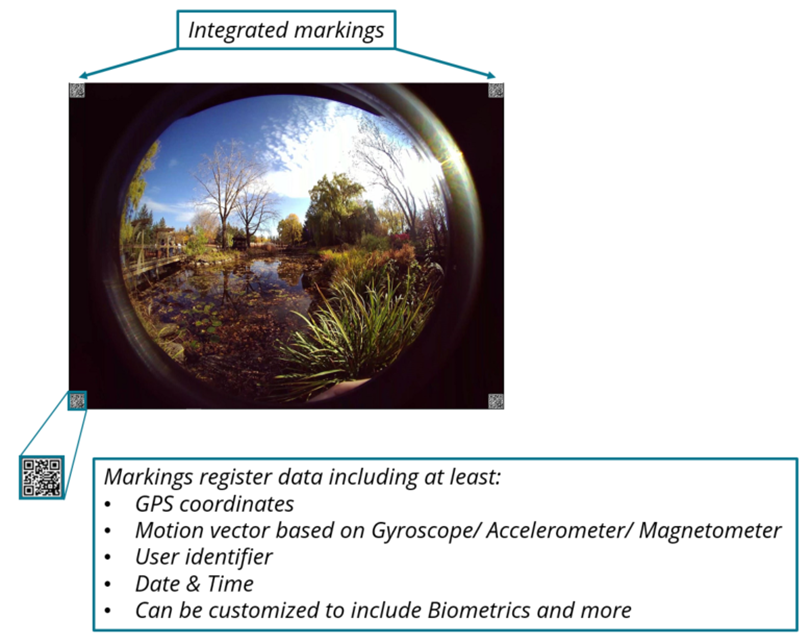
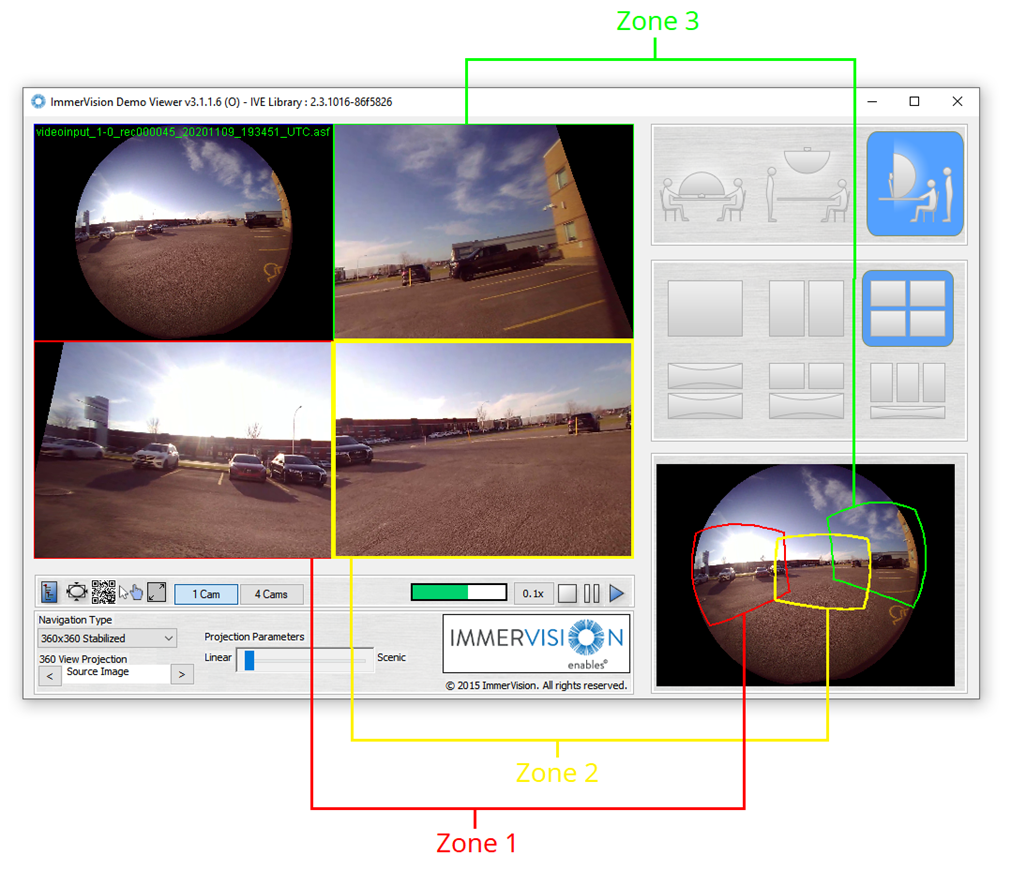
During video playback this information is used to dewarp the image (the lens ID is the key here) and apply field of view stabilization (the data from the 9-axis motion sensor is used here), giving the operator a very stable picture, without any unwanted motion. This can be particularly useful when the person wearing the bodycam is, for instance, riding a bike/motorcycle, running on foot, or simply walking up or down a staircase inside a commercial center or airport.
When reviewing an incident, the Panomorph lens technology provides the operator with the flexibility to select several zones of interest within the image, dewarp, stabilize and display them as “virtual cameras”. It's like having more cameras filming the same scene, but without the complexity associated with deploying such a system.
Integration to existing physical security systems
Cameras equipped with a Panomorph lens can leverage existing network infrastructure. There is no need to have any additional bridge or other special adapter for physically interfacing with the currently installed surveillance & security system. The Panomorph lens is a passive optical component of the PERCEPT Body Camera. To make the transition even smoother, the PERCEPT Body Camera employs the latest H.265 (HEVC) compression, which can significantly decrease bandwidth (up to 50% reduction depending on analyzed scene, motion, lighting, etc.), while maintaining similar or even better image quality compared to the current industry standard H.264 codec.
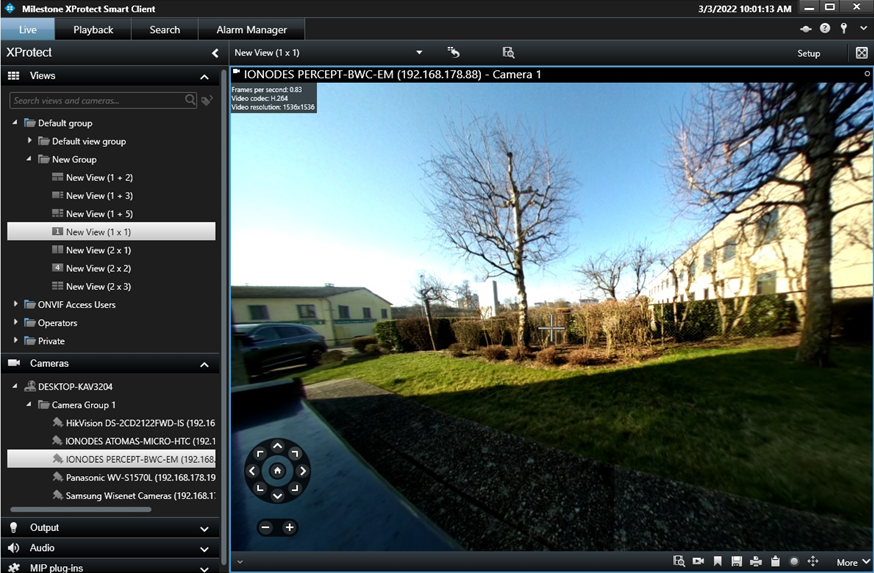
Integration to a back-end video management system (VMS) is another area where Panomorph lens technology holds a big advantage. The image produced by a fisheye or Panomorph lens is warped, therefore image dewarping technology is required to flatten the view to a format human eyes are accustomed to. Some VMS vendors have their own standard dewarping algorithm for fish-eye lenses, but since there is a lot of variation on the market in terms of their optical characteristics, this may not be optimal for all products from all vendors. Typically, a custom integration for a fish-eye lens takes a long time and is highly business-driven. The PERCEPT Body Camera Panomorph lens is already supported by industry-leading VMS companies like Genetec, Milestone and Eagle Eye Networks, which means the user can enjoy the benefits of Panomorph lenses right away, without having to wait for a custom integration.
Conclusion
With its innovative Panomorph lens and other state-of-the-art features, the IONODES PERCEPT Body Camera raises the bar on what a body-worn surveillance platform can achieve.