Media (Audio/Video) Encryption in the PERCEPT body camera
Introduction
Encryption is the basic building block of data security. It lets you protect the data you send, receive, and store on your PERCEPT Body Camera. Data is essentially converted from a readable format into an encoded format, and only those who have a decryption key can decipher it. This prevents malicious parties from accessing sensitive information or eavesdropping on your transmission. In this article we’ll explain how encryption is handled on the PERCEPT Body Camera, when data is both at rest, as well as in transit.
Encryption at rest
When your PERCEPT Body Camera is set to record locally, the audio/video data it captures is stored on its internal SD card. If data is not encrypted, a malevolent person could potentially disassemble the camera, take out the SD card and access the contents. We avoid this scenario by using 256-bit AES encryption to secure data at rest. Basically, all media (audio/video) files are encrypted prior to being written to the disk. The contents of those files are then only accessible to a user that knows the encryption key. The system administrator can easily enable or disable the encryption feature (by defining a new encryption key or respectively clearing the existing one) for the recorded media files from the body camera’s web interface.
With Advanced Encryption Standard (AES) encryption, both the sender and the receiver of data must have the same encryption key to read the data. 256-bit AES encryption is a technique that uses a key length of 256 bits for this process. Because key combinations increase exponentially with key size, the AES-256 key has the mathematical equivalent of 2256 possible combinations.
Encryption in transit
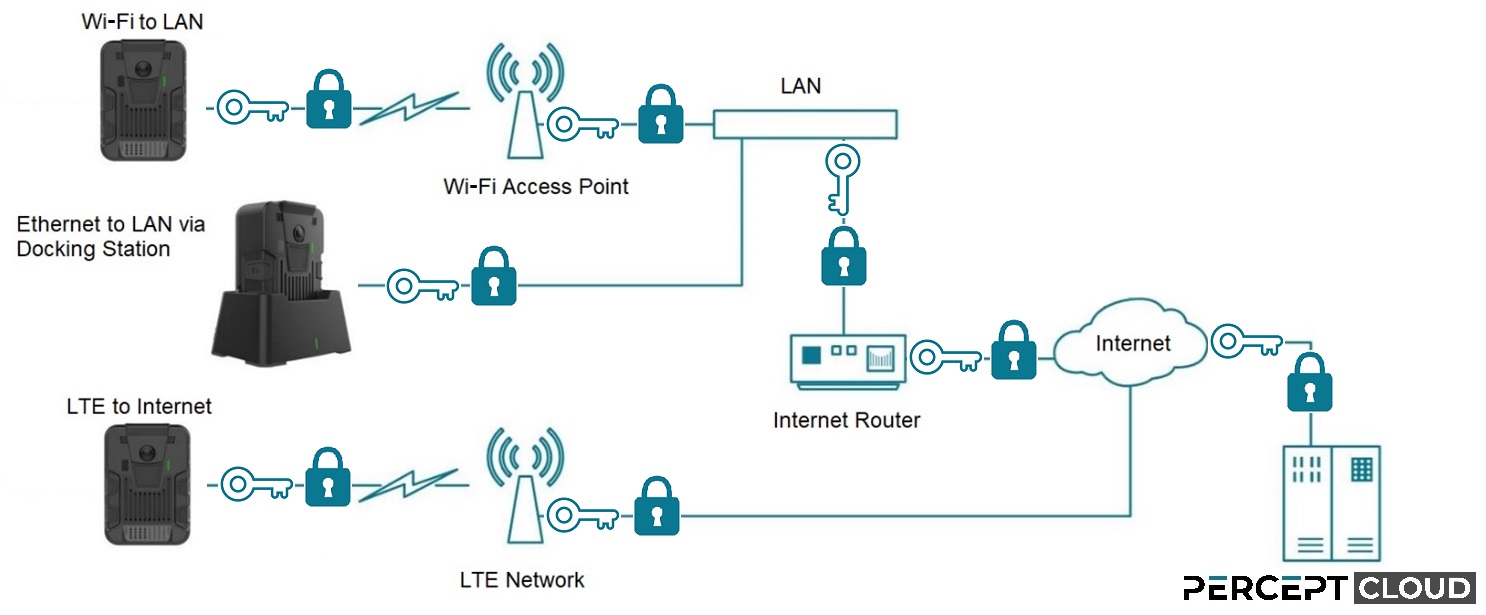
When data from your PERCEPT Body Camera is transmitted over the Internet to a storage platform there is the risk of an external entity accessing or manipulating the information. To mitigate this risk, exclusively with our PERCEPT Cloud platform, the connection is always encrypted with HTTPS and TLS version 1.2. Transport Layer Security (TLS) is a protocol that provides end-to-end security for data sent over the Internet. TLS ensures your data is encrypted and authenticated, and that the data is not tampered with while in transit between applications. This ensures a full end-to-end encrypted path, and this applies irrespective of the network connection (Wi-Fi, LTE, Ethernet) used on the PERCEPT Body Camera to get access to the PERCEPT Cloud, since TLS protocol works on a higher layer of the OSI (Open Systems Interconnection) stack.
When using API commands to retrieve recorded media clips from the PERCEPT Body Camera (when offloading locally stored video to an on-premises VMS via the ONVIF protocol, at the end of a security guard’s shift for example) the decryption is done in the device itself on-the-fly. To the outside entity (in this case the VMS using ONVIF), a decrypted stream is presented. It is therefore recommended that extra cyber-security measures are put in place by the system administrator to ensure no data theft is possible during this transfer.
Conclusion
With the PERCEPT Body Camera and the PERCEPT Cloud service, our customers can rest assured that their recorded data is in safe hands.